Choosing a college, applying for scholarships, or preparing documents for work often means looking closely at your grades. During this process, you may come across different grading terms such as General Weighted Average (GWA), Grade Point Average (GPA), and weighted average. Although these terms sound similar, they do not mean the same thing.
Understanding the difference between GWA, GPA, and weighted average helps you read your academic records correctly and avoid mistakes when filling out applications. Many Filipino students also become confused when schools ask for GPA even though their transcript only shows GWA.
This article explains what each grading system means, how it is calculated, where it is used, and why the differences matter for your education and career.
What Is GWA?
General Weighted Average (GWA) is the grading system commonly used by colleges and universities in the Philippines. It measures your overall academic performance by combining your grades from all enrolled subjects while considering the number of units or credit hours assigned to each subject.
A subject with more units has a greater impact on your final GWA than a subject with fewer units. This approach reflects the amount of work and academic importance assigned to each course.
Most Philippine colleges use a grading scale where lower numerical values represent better performance. For example:
- 1.00 – Excellent
- 1.25
- 1.50
- 1.75
- 2.00
- 2.25
- 2.50
- 2.75
- 3.00 – Passing
- 5.00 – Failed
Keep in mind that grading scales vary among institutions, so you should always refer to your school’s official grading policy.
What Is GPA?
Grade Point Average (GPA) is widely used by universities in countries such as the United States, Canada, and Australia. Unlike GWA, GPA usually follows a point-based scale, with 4.0 being the highest in many institutions.
A typical GPA scale looks like this:
- 4.0 – Excellent
- 3.0 – Good
- 2.0 – Satisfactory
- 1.0 – Minimum passing
- 0.0 – Failed
Some schools use different scales, including 5.0 or 7.0, so there is no single international GPA standard.
When you apply to international universities, scholarship programs, or exchange opportunities, the admissions office may ask for your GPA instead of your Philippine GWA.
What Is a Weighted Average?
A weighted average is a mathematical method used to calculate an overall score while giving different levels of importance to each value.
In education, weights usually come from subject units, credit hours, or percentage contributions. For example, a major subject worth five units influences your overall average more than an elective worth two units.
Weighted averages are not limited to schools. Businesses, financial institutions, and researchers also use them to calculate averages more accurately when some values carry greater importance.
GWA itself is actually a type of weighted average because it considers both grades and subject units.
Difference Between GWA, GPA, and Weighted Average
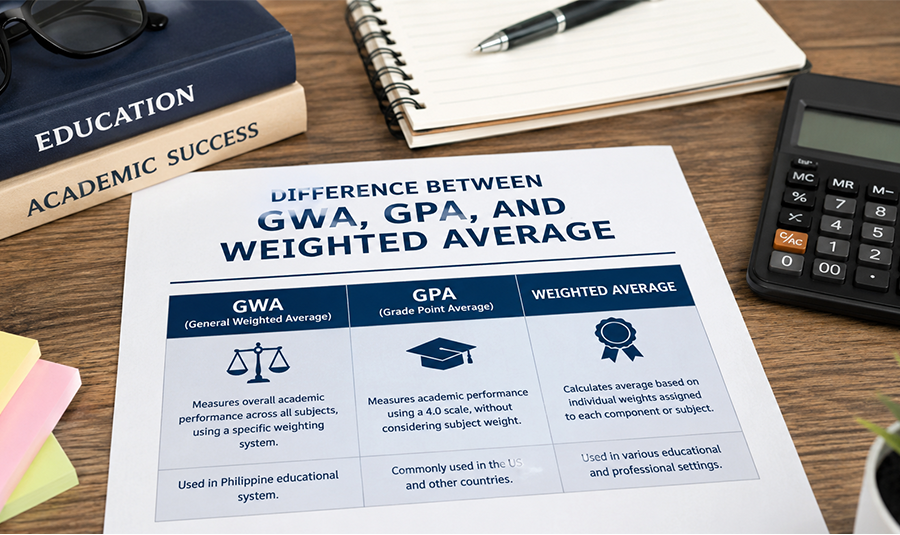
Although these terms are related, they serve different purposes. Here is a quick comparison table that explains everything:
| Grading System | Main Purpose | Common Use |
| GWA | Measures overall academic performance using subject units | Philippine colleges and universities |
| GPA | Measures academic performance using a grade-point scale | International schools and universities |
| Weighted Average | Mathematical method for combining values with different weights | Education, finance, business, and research |
The biggest difference is that GWA and GPA are official grading systems, while a weighted average is simply the calculation method used in many scoring systems.
How Is GWA Calculated?
Most schools calculate GWA using a simple formula.
Step 1: List all your subjects
Write down every subject you completed during the semester or academic year.
Step 2: Record the grade and units
Next to each subject, write your final grade and the number of units assigned.
Step 3: Multiply each grade by its units
Multiply the numerical grade by the corresponding number of units.
For example:
- Mathematics: Grade 1.50 × 3 units = 4.50
- English: Grade 2.00 × 3 units = 6.00
- Science: Grade 1.25 × 4 units = 5.00
Step 4: Add all weighted grades
Combine all the results from each subject.
Step 5: Divide by the total number of units
Divide the total weighted grades by the total enrolled units.
The result is your General Weighted Average.
Many schools now provide a GWA calculation tool through their student portals, making the process much easier.
Can You Convert GWA to GPA?
Many students applying abroad ask about GWA to GPA conversion. While conversion tables exist, there is no universal formula because schools around the world use different grading scales.
Some universities evaluate transcripts individually instead of relying on automatic conversions. Others use credential evaluation agencies to compare grading systems fairly.
Before converting your grades, always check the specific instructions provided by the institution where you are applying.
Why Do Schools Use Different Grading Systems?
Different grading systems reflect different educational policies and traditions.
Philippine colleges have long used GWA because it aligns well with local academic standards and transcript formats. Meanwhile, many international institutions use GPA because it provides a standardized point system that works across different educational programs.
Neither system is inherently better. They simply serve the needs of different educational institutions.
Why Understanding These Terms Matters
Knowing how these grading systems work helps you avoid mistakes during important academic and career applications.
You may need this knowledge when:
- Applying for scholarships
- Transferring to another college
- Studying abroad
- Preparing employment requirements
- Comparing academic records
- Meeting Philippines universities admission requirements
Employers and admissions officers often review academic records carefully, so understanding the grading system shown on your transcript helps you provide accurate information.
How Can You Monitor Your Academic Performance?
Keeping track of your grades allows you to identify areas that need improvement before the semester ends.
Here are a few practical habits:
- Review your grades after every examination.
- Monitor assignment and project scores.
- Calculate your expected semester average regularly.
- Ask your instructors when grading policies are unclear.
- Save copies of official transcripts and grade reports.
Many schools now support checking academic performance online through secure student information systems. These portals allow students to view grades, enrollment records, and academic updates without visiting campus.
Frequently Asked Questions
Is GWA the same as GPA?
No. GWA and GPA measure academic performance differently and often use different grading scales. GWA is commonly used in Philippine higher education, while GPA is more common internationally.
Is weighted average the same as GWA?
Not exactly. A weighted average is the calculation method. GWA is one academic grading system that uses a weighted average formula.
Does every Philippine school use the same GWA scale?
No. Schools have their own grading policies, passing marks, and numerical scales. Always consult your institution’s handbook or registrar for official information.
Why do subject units matter?
Subjects with more units require more academic work, so they contribute more to your overall average than subjects with fewer units.
Are senior high school grades calculated the same way?
Some schools use different grading methods during the K12 education system, while colleges generally follow their institutional GWA policies.
Conclusion
Understanding the Difference Between GWA, GPA, and Weighted Average makes it easier to interpret your transcript, prepare application documents, and compare academic records correctly. GWA measures overall performance in most Philippine colleges using subject units. GPA uses a grade-point scale that many international institutions recognize. A weighted average is the calculation method that gives more importance to subjects with higher credit values.
As you review your college results, always refer to your school’s official grading policy before making comparisons or converting grades. Knowing how these systems work helps you make informed academic decisions and submit accurate information when applying for scholarships, universities, or future career opportunities.